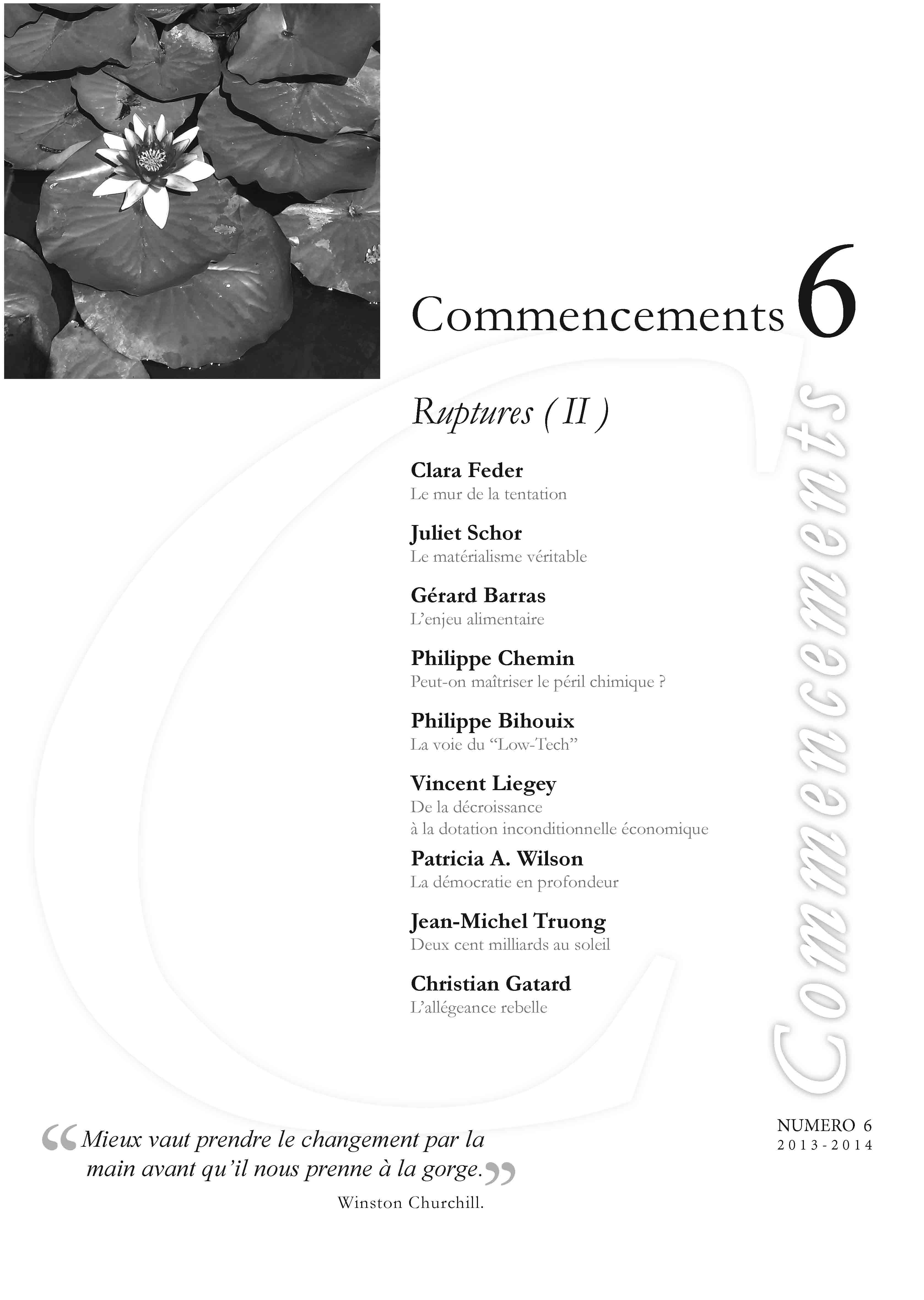
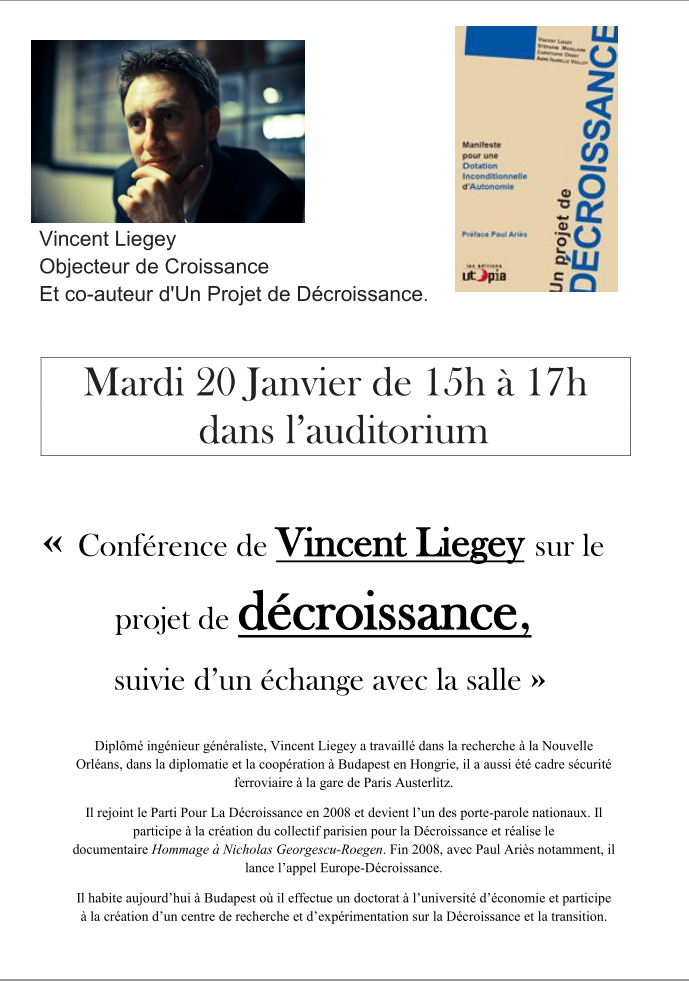
« Un Projet de Décroissance » et la voie du « low tech » dans Commencements 6

Commencements06-Decroissance-LiegeyDe la décroissance à la dotation inconditionnelle d’autonomie, interview de Vincent Liegey dans le numéro 6 de Commencements :

« Avec quels leviers psychologiques, économiques, culturels, sociaux, politiques, institutionnels, etc. peut-on jouer pour sortir de l’impasse dans laquelle se trouve notre société ? »

« Nous vivons dans une société où la peur est très présente et surtout la peur liée à l’économie. »

« Il s’agit de semer des graines d’espoir: l’espoir que, lorsque se présenteront certains évènements, on ne basculera pas dans la barbarie mais dans la transition.« 

Retrouver aussi l’excellente et complémentaire interview de Philipe Bihouix, La voie du « low tech » :

« Plus on miniaturise, plus on intègre, plus le produit sera difficile à réparer, à recycler.« 

« Si l’on n’accepte pas l’intermittence du côté de la demande, ce qu’on a besoin d’installer du côté de l’offre est délirant.« 

« C’est malheureux à dire, mais la seule vraie voiture propre, c’est le vélo.« 

« Nous méritons un monde bien plus charmant, bien plus agréable, une société plus solidaire et plus joyeuse, une civilisation apaisée, respectueuse de la nature et techniquement soutenable.« 

A lire en PDF :

Merci à Thierry Groussin pour ces textes.

Publié dans Actualités, Dans la presse et sur la toile | 4 commentaires

A Degrowth Project: « And What If We No Longer Had To Work? » – Vincent Liegey in Reporterre

ReporterreIn order to move beyond a productivist vision of life, we have to question the notion of work itself, which, for the most part, serves to sustain a system of profound inequality. We need to break from “sacrosanct economic growth”, “abandoning work-based ways of thinking, putting the economy and our obsession with the bottom line back where they belong, rejecting the view that everything revolves around work!”

Not a day goes by without someone vilifying the unemployed, labeling them “charity cases”, “profiteers”, or “those damned jobless people” who “have no interest in getting a job”! They must be kept in check. We must watch their every move.

Above all, they too have to do their part in getting the economy back up and running in the great productive endeavor – even if that means jeopardizing their own lives – producing more and more, keeping the mighty machine running while jump-starting sacrosanct economic growth. “Green” growth, if possible. All to further enrich the oligarchy!!

OK then, let’s get to work: but doing what? Continuer la lecture

Publié dans A Degrowth Project | Un commentaire

Débat dans l’Humanité : Doit-on penser les problèmes économiques en termes de croissance ou de décroissance ?

A l’initiative du forum « Demain le monde », une controverse productive était organisée le 17 décembre 2014 à l’auditorium du Mac Val sur le thème « Croissance et décroissance sont-elles les seules alternatives pensables ? ». Voici les textes issus des interventions de cette rencontre :
– Fabrice Flipo, philosophe
– Notre contribution : « Un projet de décroissance, manifeste pour une dotation inconditionnelle d’autonomie »
– Marie-Claire Cailletaud, porte-parole de la Fédération nationale
des mines et de l’énergie CGT.
– Alain Obadia, président de la Fondation Gabriel-Péri.
Le débat est ouvert dans l’Humanité du MARDI 3 FÉVRIER, 2015.

  • Un enjeu de fond, un débat qui durera par Fabrice Flipo, philosophe

Continuer la lecture

Publié dans Dans la presse et sur la toile | Laisser un commentaire

Chronique Reporterre : La décroissance se lève à l’est

ReporterreNous publions régulièrement des chroniques sur l’excellentquotidien de l’écologie Reporterre.net : 

« Comment critiquer la surconsommation dans des sociétés qui l’attendent toujours ? » Et pourtant, la question trouve un terrain fertile à Budapest, qui accueillera la prochaine Conférence internationale sur la décroissance.

J’ai participé les 24 et 25 janvier à l’organisation d’une rencontre régionale sur la décroissance dans les « pays de l’est » (Nemnövekedés). Une centaine de personnes d’une vingtaine de nationalités ont participé à ces deux journées à Budapest.

Décroissance ou austérité ? Continuer la lecture

Publié dans Actualités, Dans la presse et sur la toile | 2 commentaires

« Un Projet de Décroissance » sur Radio Eveil


Radio Eveil : « Vincent Liegey nous parle de la décroissance, du revenu de base et de la dotation inconditionnelle d’autonomie. J’ai eu le bonheur de passer du temps avec lui et c’est avec des gens comme lui que la croyance d’un monde meilleur arrive.
Interview pendant les universités d’été du Revenu de base – Réseau France
– Vincent Liegey, doctorant sur la Décroissance à l’université d’économie de Budapest (porte-parole du PPLD depuis janvier 2008).
– Stéphane Madelaine, professeur de Sciences Industrielles pour l’Ingénieur en Classes Préparatoires aux Grandes Écoles (membre du conseil national du PPLD).
– Christophe Ondet, gestionnaire de collège (ancien secrétaire national du PPLD).
– Anne-Isabelle Veillot, auxiliaire de vie scolaire (secrétaire nationale du PPLD). »
www.Projet-Decroissance.net

Merci Alexandre Lecouillard pour cette discussion.

Publié dans Actualités, Dans la presse et sur la toile, Multimédias | 2 commentaires

La DIA/RMA en BD dans La Gazette de Gouzy

Cliquez sur l’image pour lire la Gazette.
Ou télécharger le fichier d’impression pour imprimer la Gazette.

N’hésitez pas à la partager la source : clic


Publié dans Actualités, Dotation Inconditionnelle d'Autonomie, Multimédias | Un commentaire

Succesful and fruitful Degrowth workshop in Budapest – The Right Great Transformation is underway!

After Ljubljana in 2013, Zagreb in March, Sofia in May and Leipzig in September 2014, a two-day long regional workshop on Degrowth in postsocialist countries took place in Budapest on the 24-25 January 2015.

Around 100 people from about 20 countries participated during the two days of activities. A Degrowth Project participated as well.
On the first day of the participatory workshop, discussions, and brainstorming activities took place in small and large groups. Several issues were debated such as Degrowth and inequalities, Degrowth and the gift economy, Basic Income, Degrowth as a provocative slogan and how could it be used in other languages, Degrowth in practice, Degrowth and education, Degrowth in post-socialist countries, East-West interrelations and dialogue, etc.

DSC04991The lunch was made with local food sourced directly from the organic farm in Zsambok. Many thanks to the self-managed kitchen team who prepared delicious beetroot, onion and carrot salads, körozöt and potato stew. Also thanks to all the participants and all the products shared.

We concluded this first day with an open discussion about public debt and extractivism with Nicolas Sesiron from the Committee for the Abolition of Third World Debt.
DSC04989Finally, before a convivial party contemplating the falling snow and the Buda hills,  Miklos Antal gave a talk about the physical limits to growth, explaining why sufficiently fast decoupling is very unlikely. Then Vincent Liegey presented the cultural limits by questioning why the quest for more is far away from a meaningful life. Convivial discussions on how to reappropriate hope and conviviality carried on until late night.

DSC04985The second day was spent focusing on concrete alternatives and self-organisation for future projects. We were first welcomed by Edina of the Szimpla backyard small producers’ market who presented the cultural and community development activities surrounding the weekly food market. Afterwards Logan from the organic farm of Zsambok explained why direct market of this nature are important to, on one hand find opportunities to directly sell the products, and on the other hand to implement trustful and transparent relationships between the consumers and the producers.

Also in the warm and special atmosphere of the market, we had a session on the application to host the next Degrowth Conference in Budapest with a regional organisation. After lunch in the market, we departed on foot, on a sightseeing walk in wonderful Budapest, to Noha Studio, where Adrien presented all the workshops and activities happening there. He also presented Cyclonomia’s activities, Do it Yourself bike and low tech shop, where we had a meeting about upcoming events and projects we could implement.

Also people from diverse backgrounds could share their different experiences, in particular connected to local alternatives.
Again thanks to all the participants and all the people who contributed to this succesful organisation. In particular, thanks to Adrien, Orsi, Laura, Dimas, Logan, Edina, Peter, Adela, Dan, Tamara, Miklos, Mladen, Ajda, Jutka, Lidija, Gabi, Szabina, Tone, Blanka, Christina and a lot of other for their precious help and contributions. Everything was organised based on reciprocity economy principles. We received free donations which help us to balance the budget in supporting local partners.

In Budapest, Karl Polanyi’s town, we could enjoy a new Great Transformation which is underway… But that one, is based on Degrowth. That’s one is the right one.

To go further:
Publié dans A Degrowth Project | Laisser un commentaire

Et si tous les Charlies se réappropriaient la politique ?

pas de coté« Le capitalisme canalise les frustrations des hommes, les empile, comme il accumule le capital, et fait gonfler des bulles qui finissent par crever comme des bombes. » Bernard Maris

Il y a presque 20 ans sortait sur les écrans La Haine. Ce film raconte l’histoire de notre pays, la France, en chute libre : « au fur et à mesure de sa chute se répète sans cesse pour se rassurer : jusqu’ici tout va bien, jusqu’ici tout va bien, jusqu’ici tout va bien. Mais l’important n’est pas la chute, c’est l’atterrissage. »
Nous ne voulions pas voir la chute. Nous venons de nous prendre en pleine figure cet atterrissage d’une terrible violence. Cette tragédie n’est que la partie émergée, spectaculaire, d’un mal bien plus profond.

Notre société crée des monstres. Ces monstres sont nés en France et ont grandi en France. Comment se fait-il que notre société échoue à faire grandir des enfants dans un environnement serein et apaisé ? Comment se fait-il que des franges entières de la population se réfugient dans des communautés étanches, voire hostiles, les unes des autres, qu’elles soient religieuses ou pas (la religion n’explique pas tout) ?

N’est-ce pas là une nouvelle occasion d’interroger notre modèle de développement occidental ? Sommes-nous assez irresponsables, voire cynique, pour prétendre qu’il est le père de sociétés sereines, paisibles et fraternelles ? Sommes-nous assez naïfs pour s’étonner de la haine et des violences qu’il enfante ? Continuer la lecture

Publié dans Actualités | 5 commentaires

« Un Projet de Décroissance » au Lycée


« Un Projet de Décroissance » sera au Lycée Français de Budapest le mardi 20 janvier 2015 :Liegey-projet-decroissance-lycee-francais-budapest

Publié dans Actualités | Laisser un commentaire

Degrowth radio: Open Source on Radiozora

Tonight, live on Radiozora, Chill channel from 7 pm: Cargonomia

As a peak of our Open Source series, this episode celebrates the birth of Cargonomia, a forward-looking project that blends several socially and environmentally conscious ideas and movements that include Cyclonomia Do it Yourself Bicycle Social Cooperative, Zsamboki Biokert, an organic vegetable farm and sustainable agriculture community education center which distributes weekly vegetable boxes to food communities in Budapest, and Kantaa, a self organized bike messenger and delivery company”.

We made a first radio programme on Radiozora in July 2014, Introduction to Degrowth:

We decided to keep going with a monthly programme « Open Source » and met again in September 2014:

Degrowth and food production with Logan and Zsámbok Organic Garden:

Degrowth and DiY, low-tech and Cyclonomia:

Degrowth sources: Karl Polanyi and Nicholas Georgescu-Roegen:

Degrowth and Transition network with Tracey Wheatley and Transition in Hungary.

Our last programme was (soon online): Degrowth sources 2: Ivan Illich, Cornelius Castoriadis and André Gorz.

With Sara Feher and Vincent Liegey.
Thanks Adrien, Logan, Tracey and Radiozora.

Publié dans A Degrowth Project, Multimédias | 2 commentaires